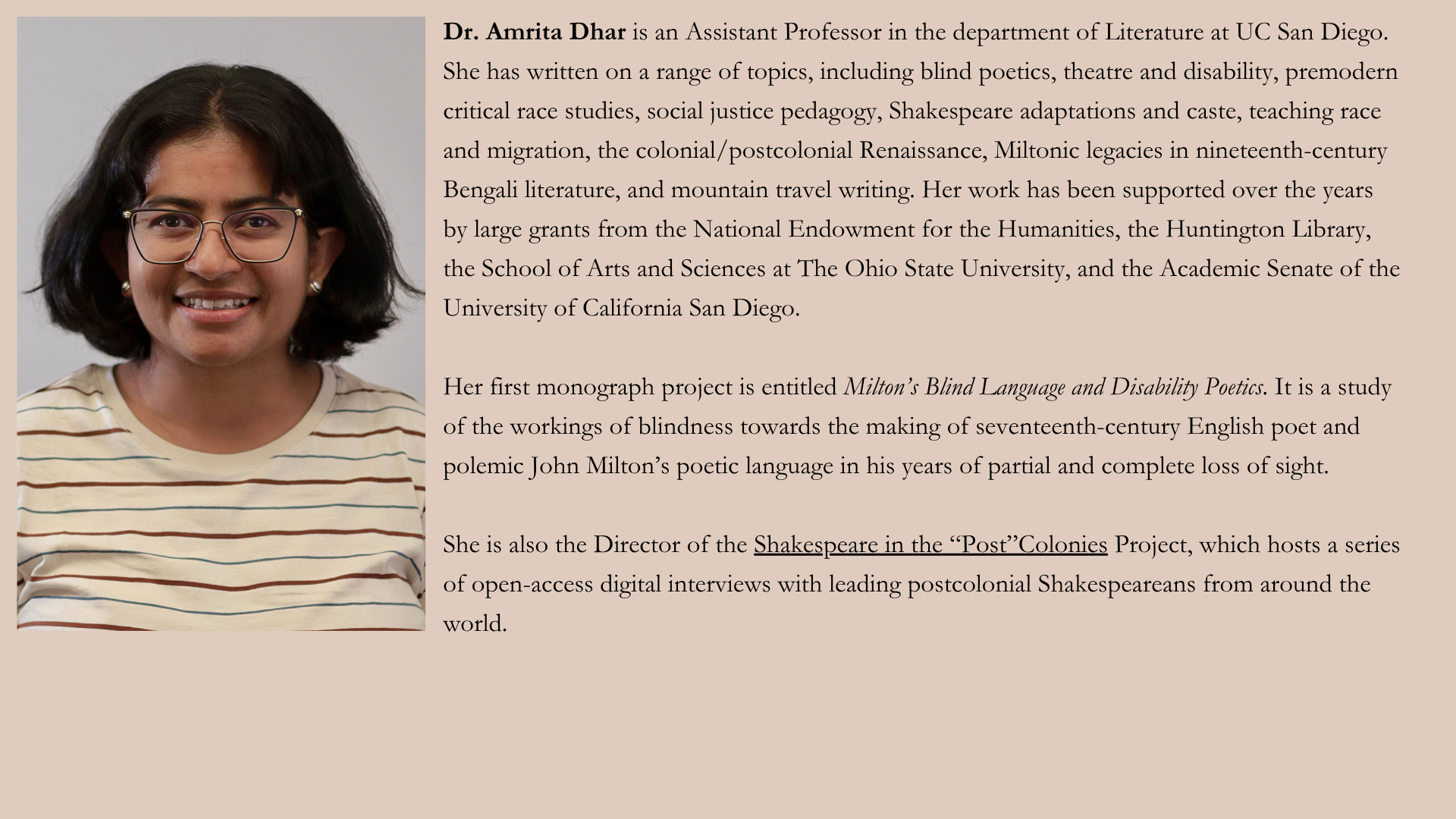
We are delighted to be welcoming Dr. Amrita Dhar (UC San Diego), who will deliver a talk on Shakespeare and postcolonialism. We will be meeting at 12:30pm on Monday 12th October in Bush House (SE), Room 4.16.
To attend, please sign up here: https://www.tickettailor.com/events/centreforearlymodernstudies/2450098
Lunch will be provided.
Talk Abstract
What does it mean to think postcolonially about Shakespeare? (What is postcolonial? Why bring Shakespeare into it? What has Shakespeare to do with the postcolonial?) This talk takes as its starting point the curious and interlocked facts that, first, there has never been a genuine “post” or after of empire in the world, and second, that in our unequal world persists a surprising and powerful means of postcolonialism and liberatory thinking: Shakespeare. Shakespeare has historically been a means of imposing colonial education and racial hegemony. Part of the common-core school curriculum in a staggering number of countries to this day, Shakespeare entered the university curriculum for the first time in the early nineteenth century, c. 1822, in Calcutta (present-day Kolkata), which was the capital of the British Raj from 1772 to 1911. Calcutta University had pedagogical jurisdiction over a vast geography ranging from Lahore, in present-day Pakistan, to Rangoon, which is present-day Yangon, in Myanmar. Shakespeare featured prominently in the curriculum meant to teach the superiority of English poetry, theatre, language, and culture. Shakespeare thus became an instrument of colonial ideology.
But then, something strange happened. The poetry and stories of Shakespeare—in the manner of all truly remarkable stories and poetry—began to exceed and subvert their immediate and violent context. Shakespeare came to be appropriated to tell the histories, identities, and dreams of the populations that the colonial rule was meant to control. This phenomenon of powerful appropriation and creative use of Shakespeare in the service of human responsibility and liberation took place not only in South Asia, where I grew up in Calcutta, but also in East Asia, in about twenty countries in Africa, in Australia and New Zealand, and among Native and sovereign nations in what are now Canada and the United States. Today, we know from the teachings of scholars such as Patrick Wolfe that colonialism is a structure, not an event. Remarkably, the reception of Shakespeare in postcolonial contexts disrupted—disrupts—that structure and persists as a resistance to colonial power in spaces as diverse as the borderlands of the United States and Mexico; the heart and reach of Bollywood in Mumbai and across the world; post-Apartheid South Africa and theatres of Nigeria and Kenya; and Indigenous theatre companies of Canada and Australia. Yet owing to the old and colonial way of division and demarcation, most of us of post-colonial inheritance and postcolonial backgrounds do not know the stories and achievements of others of us of post-colonial inheritance and postcolonial backgrounds. There is yet no interconnected study of the various Shakespearean postcolonialisms that sustain many revolutionary creative pockets of the world. This talk will discuss, with a few situated examples, the importance of following the historically parallel—albeit distinct—developments of Shakespearean postcolonialisms in Africa, Australasia, Asia, and North America.